
Trifluoroacetic Acid
Trifluoroacetic acid is a corrosive organofluorine compound that is structurally analogous to, but stronger than, acetic acid. Available in various quantities and reagent grades, it is used in NMR spectroscopy, mass spectrometry, organic synthesis, etc.
Almost 100,000-fold more acidic than acetic acid, TFA is widely used in organic chemistry. TFA is used as a reagent in organic synthesis because of its properties: volatility, organic solvent solubility, and acidic strength. It is less oxidizing than sulfuric acid and is more readily available in its anhydrous form than some other acids . Other features include:
- Used in acid-catalyzed reactions, especially peptide synthesis (to cleave esters)
- Dissolves protein when mixed with liquid SO2
- Removes t-butyl derived side-chain protecting groups in Fmoc peptide synthesis
- Can remove the t-butoxycarbonyl protecting group in organic synthesis
- At low concentrations, acts as an ion-pairing agent for peptides and small proteins in organic compound liquid chromatography
- For acid-stable materials, can be a solvent for NMR spectroscopy
- Acts as a calibrant in mass spectrometry
- Used to produce trifluoroacetate salts
- An ingredient in adhesives, sealants, paints, and coatings
When TFA combines with bases and metals, especially light metals, a strong exothermic reaction occurs. When mixed with lithium aluminum hydride (LAH), the reaction is explosive.
Although nonflammable, TFA is corrosive to skin, eyes, and mucous membranes and requires careful use and handling. It is harmful when inhaled, causes severe skin burns and eye damage, and is toxic to aquatic organisms at even low concentrations.
TFA is also a product of the metabolic breakdown of the anesthetic agent halothane. It is the suspected cause of halothane-induced hepatitis.


Trifluoroacetic Acid, Reagents
CAS: 76-05-1 Molecular Formula: C2HF3O2 Molecular Weight (g/mol): 114.02 MDL Number: MFCD00004169 InChI Key: DTQVDTLACAAQTR-UHFFFAOYSA-N Synonym: Perfluoroacetic Acid, Trifluoroethanoic Acid IUPAC Name: trifluoroacetic acid SMILES: OC(=O)C(F)(F)F

Trifluoroacetic Acid, For protein sequencing, Solstice
CAS: 76-05-1 Molecular Formula: C2HF3O2 Molecular Weight (g/mol): 114.02 MDL Number: MFCD00004169 InChI Key: DTQVDTLACAAQTR-UHFFFAOYSA-N Synonym: trifluoroacetic acid,perfluoroacetic acid,trifluoroethanoic acid,trifluoroacetic acid,acetic acid, trifluoro,trifluoroaceticacid,cf3cooh,trifluoro acetic acid,trifluoro-acetic acid,kyselina trifluoroctova PubChem CID: 6422 ChEBI: CHEBI:45892 IUPAC Name: trifluoroacetic acid SMILES: OC(=O)C(F)(F)F

Acetonitrile with 0.1% Trifluoroacetic acid, LabReady™ Solvent Blend, Solstice
CAS: 75-05-8 Molecular Formula: C2H3N Molecular Weight (g/mol): 41.053 InChI Key: WEVYAHXRMPXWCK-UHFFFAOYSA-N Synonym: methyl cyanide,cyanomethane,ethanenitrile,methanecarbonitrile,ethyl nitrile,methane, cyano,acetonitrile,cyanure de methyl,methylkyanid,mecn PubChem CID: 6342 ChEBI: CHEBI:38472 IUPAC Name: acetonitrile SMILES: CC#N
Acetonitrile with 0.035% Trifluoroacetic acid, LabReady™ Solvent Blend, Solstice
CAS: 75-05-8 Molecular Formula: C2H3N Molecular Weight (g/mol): 41.053 InChI Key: WEVYAHXRMPXWCK-UHFFFAOYSA-N Synonym: methyl cyanide,cyanomethane,ethanenitrile,methanecarbonitrile,ethyl nitrile,methane, cyano,acetonitrile,cyanure de methyl,methylkyanid,mecn PubChem CID: 6342 ChEBI: CHEBI:38472 IUPAC Name: acetonitrile SMILES: CC#N
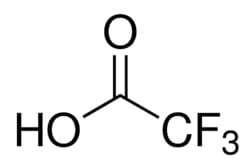
Sigma Aldrich Fine Chemicals Biosciences Trifluoroacetic acid | 76-05-1 | MFCD00004169 | 10 x 1 mL
Trifluoroacetic acid | Purity: 99% | Mol Wt: 114.02 | 76-05-1 | MFCD00004169 | 10 x 1 mL


Covachem LCMS Grade TFA (Trifluoroacetic acid) 25ml
CovaChem's LCMS Grade Trifluoroacetic acid (TFA) is well suited as a chromatography additive for difficult to separate analytes in HPLC and LCMS applications. CovaChem's LCMS TFA is an ideal additive for separations of peptides in peptide synthesis applications. Trifluoroacetic acid is widely used to separate both protected amino acid chains and deprotected peptides. Due to the amino and carboxylate groups having vastly different pka values, synthetic peptides can be particularly challenging to separate, The HPLC separation of peptides is much more easily achieved with 0.1% Trifluoroacetic acid being present in the mobile phase.

Proteochem Inc TFA Ampules (Proteomics Grade), 76-05-1, MFCD00004169, 10 amps
MF: C2 H F3 O2, MW: 114.03, Alternative Names: TFA Ampoules; Trifluoroacetic Acid Ampoules; TFA Amps. Trifluoroacetic acid (TFA) is an effective ion pairing agent for HPLC and proteomics LCMS applications which are regularly used to resolve chromatographically similar analytes.

Sigma Aldrich Fine Chemicals Biosciences Trifluoroacetic acid ReagentPlus(R), 99% | 76-05-1 | MFCD00004169 | 25ML
Trifluoroacetic acid ReagentPlus(R), 99% | Purity: 99% | Mol Wt: 114.02 | 76-05-1 | MFCD00004169 | 25ML

Medchemexpress LLC Nangibotide TFA | 99.36% | 1457.46 | 1 MG

Nangibotide TFA (LR12 TFA) is a synthetic peptide and a TREM-1 receptor inhibitor. It inhibits NF-κB and NLRP3 inflammasome activation and reduces the release of pro-inflammatory factors such as IL-1β and IL-8. This peptide also inhibits apoptosis, reducing excessive inflammatory responses and protecting tissues from damage. It can be used in research for myocardial ischemia-reperfusion injury, septic shock, acute lung injury, osteoarthritis, and acute liver failure.
- Inhibits NF-κB and NLRP3 inflammasome activation
- Reduces release of pro-inflammatory factors like IL-1β and IL-8
- Protects tissues (liver, lung) from damage
- Can be used in research for various inflammatory and injury conditions
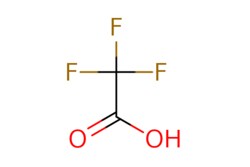
eMolecules 76-05-1 | Trifluoroacetic acid | Chem-Impex | MFCD00004169 | 114.023 | C2HF3O2 | 99.000 | OC(=O)C(F)(F)F | 1kg | 272384819
Trifluoroacetic acid | Chem-Impex | 76-05-1 | MFCD00004169 | 114.023 | C2HF3O2 | 99.000 | OC(=O)C(F)(F)F | 1kg | 272384819
Medchemexpress LLC FStAx-35R TFA | 97.4% | 2885.36 (free base) | 1 MG
fStAx-35R TFA is a hydrocarbon-stapled peptide that inhibits the Wnt/β-catenin signaling pathway by disrupting the β-catenin-TCF interaction. It can be utilized in cancer research.
- Inhibits Wnt/β-catenin signaling pathway
- Disrupts β-catenin-TCF interaction
- Suitable for cancer research
Medchemexpress LLC Siivfekl (Tfa) | 99.85% | 948.16 | 1 MG
SIIVFEKL TFA is an antigenic peptide, a variant of the major MHC class I-restricted epitope SIINFEKL. It is designed to stimulate specific T cells in experimental settings to study the competitive interaction between T cells. This peptide exhibits low affinity for the OT-I T cell receptor (TCR) and is suitable for the detection of CD8+ T cells.
- Variant of the major MHC class I-restricted epitope SIINFEKL
- Stimulates specific T cells for competitive interaction studies
- Exhibits low affinity for the OT-I T cell receptor (TCR)
- Suitable for detection of CD8+ T cells
- High purity of 99.85%
- Provided as a white to off-white solid
- Stable under recommended storage conditions
Medchemexpress LLC PBX-7011 TFA | 98.6% | 561.46 | 5 MG
PBX-7011 TFA is a derivative of camptothecin. It inhibits expressions of the cancer-related survival genes DDX5, Survivin, Mcl-1, and XIAP in FaDu cells, degrades DDX5 proteins, and exhibits anticancer activity.
- Inhibits expressions of cancer-related survival genes DDX5, Survivin, Mcl-1, and XIAP in FaDu cells.
- Degrades DDX5 proteins.
- Exhibits anticancer activity.

Medchemexpress LLC Ss47 Tfa | 00-00-0 | 99.9% | 1067.09 | C51H57F3N6O14S | 5 MG
SS47 TFA is a PROTAC-based HPK1 degrader supplied as the trifluoroacetic acid salt for research use. It promotes proteasome-mediated degradation of HPK1 and is used in immuno-oncology and CAR-T cell studies.
- Research reagent for HPK1 degradation and immuno-oncology studies.
- Contains an alkyne moiety compatible with copper-catalyzed azide-alkyne cycloaddition.
- Purity 99.88%.
- Chemical formula C51H57F3N6O14S; molecular weight 1067.09.
- Soluble in DMSO at 100 mg/mL; ultrasonic assistance recommended.
- Store protected from light under nitrogen; in solvent: -80°C (6 months), -20°C (1 month).
- Available in small research pack sizes such as 1 mg, 5 mg, and 10 mg.